Working Under an Independent Sponsor Who Suddenly Passed Away
Former Chicago teacher G.R. Kearney transformed tragedy into opportunity, rebuilding his firm as Stacker Holdings—an employee-focused, EOS-driven private equity platform after his partner's sudden death.
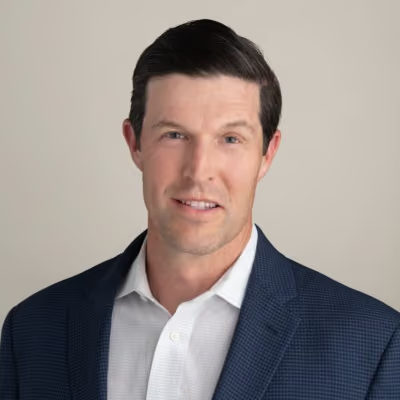

G.R. Kearney, a former inner-city Chicago teacher, was thrust into leadership when his senior partner tragically passed away. He navigated the emotional and legal complexities of sustaining the firm and ultimately rebranded it as Stacker Holdings, reshaping the platform into an employee-centric, EOS-driven, long-term investment firm.

G.R. Kearney's path into private equity: An English undergraduate major, began his career teaching at an inner-city Jesuit high school on the South Side of Chicago. In his early 20s, he spent his nights writing long-form projects, including a book-length history of the school. That work led him to interview a venture capitalist, a single conversation that triggered an abrupt pivot towards business. Within weeks, he was studying for the GMAT, and by 2007 he had joined a Chicago-based independent sponsor as employee #1.

Kearney's boss and senior partner died suddenly in an accident in 2018. At the time, the firm owned 4 portfolio companies, each with different operating agreements, capital partners, and lenders. Kearney and a younger colleague, Austin Reichart, worked closely with the estate to unwind. 3 businesses were sold to provide liquidity to the family, while 1 was recapped and retained. The experience highlighted how complex succession can be in deal-by-deal private equity, especially compared to a fund structure with centralized governance and documents already in place.
The retained business was Acme Finishing Company, acquired in 2015 for $7.5m at $1.3-1.4m of EBITDA after a customer loss during diligence. Within 10 months of closing, earnings fell by roughly 50% under a newly hired outside CEO. Kearney stepped in to stabilize the business and ultimately ran it for 7 years. Over a 10-year hold period, Acme has generated >3x MOIC from distributions alone.

Today, Stacker Holdings emphasizes EOS as an operating system, structured weekly and quarterly accountability, and an employee-centric culture. They prefer conservative leverage and long-term holds, and focus on being friendly owners rather than financial engineers.
More recent episodes
"An Independent Sponsor Can Be My Favorite Kind of Buyer"
Dara Shareef of Benchmark International says content now builds stronger connections than cold outreach. For independent sponsors, winning requires trust, proven capital access, a clear value-creation plan and decisive execution after the LOI.
1 Equity Raise ($500k), 4 PortCos
Andrew McDonald didn't build Fourco Holdings with a deck and a thesis. He built it by buying one small business, making it throw off cash, then buying the next one.
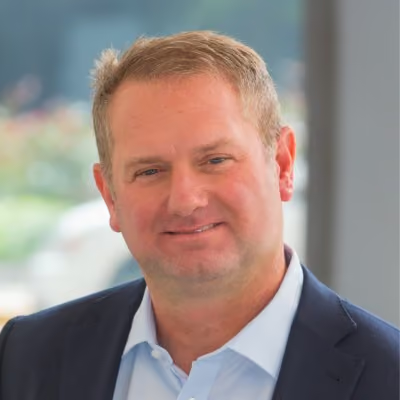
The 123-Year-Old Firm's Independent Sponsor Blitz
HKW is a 123-year-old firm that evolved from investment bank to PE investor and now independent sponsor. CEO Ted Kramer explains how 180 completed acquisitions and 25,000 tracked deals have sharpened its pattern recognition.