From Public CEO to Independent Sponsor: Jeff Goldstein's Journey
Jeff Goldstein's journey from public company CEO to independent sponsor at Breakwater Management, navigating AI challenges in marketing and finding opportunities in media.


Jeff Goldstein's career shifted from the C-suite of a public company to the entrepreneurial hustle of an independent sponsor. As he explains, the attraction lies in trading the resourcefulness & disconnection of large organizations with real impact and constraints in the lower middle market. At Breakwater, he values the chance to bring seniority and judgment to smaller companies, where variety, constraints, and hands-on involvement make the work both more demanding and more rewarding.

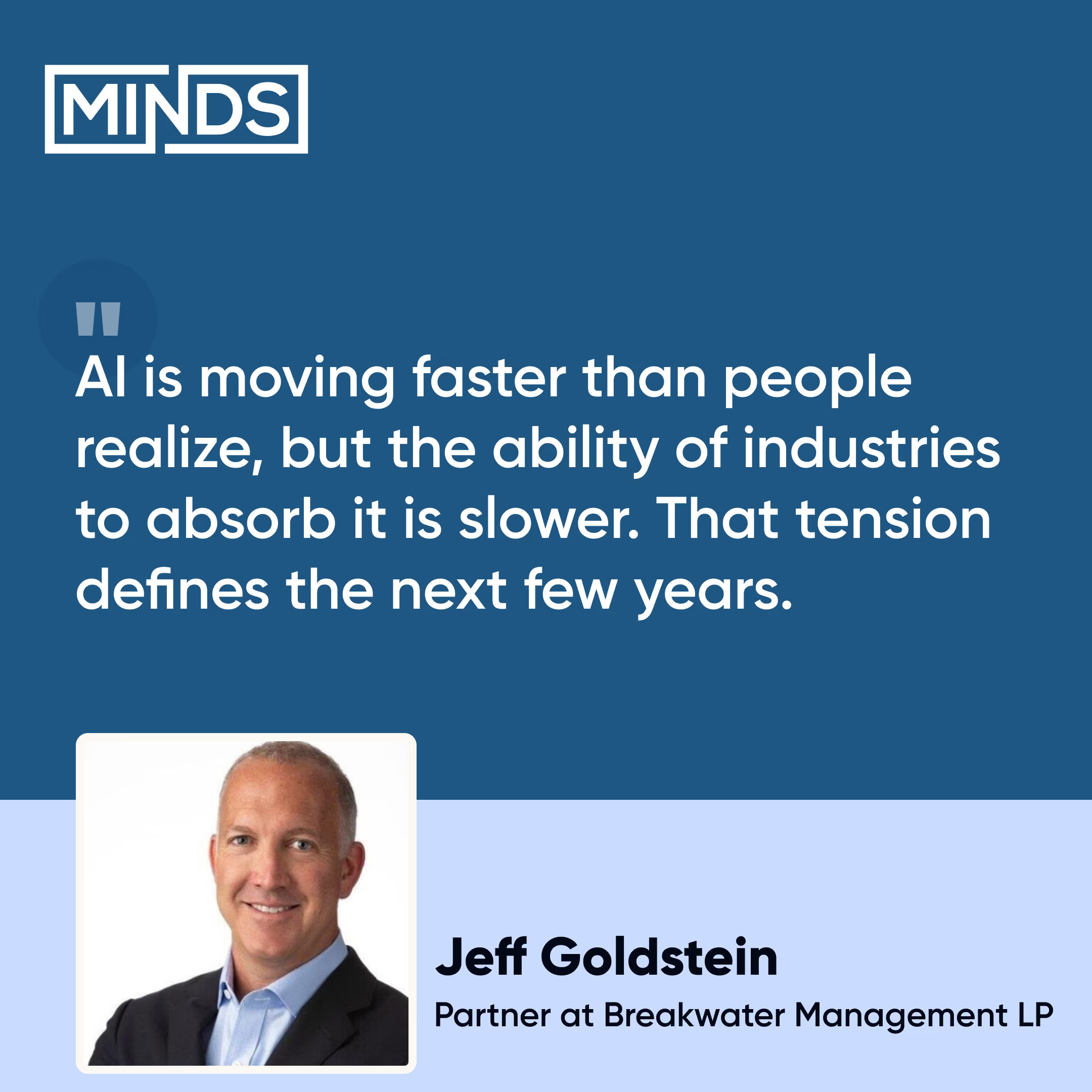
"How do you underwrite for AI," we asked Jeff, knowing that his company, Chemistry Communications, can be both enabled and hurt by AI. He stressed that AI development is advancing faster than people realize, but adoption is uneven and slower because humans can't absorb and implement AI at the rate it is developed. For a marketing agency like Chemistry, AI is a double-edged sword: it brings efficiency, personalization, and data power, yet raises existential questions of disintermediation. Jeff argues that human strategic partnership with CMOs remains essential, making AI an enabler rather than a replacement in the foreseeable future.
Jeff's move into independent sponsorship coincided with Breakwater Management's pivot from private credit into private equity. The firm had a legacy in lending, but the tragic loss of a founder prompted it to redefine its strategy. By joining, Jeff brought operating and M&A experience, while Breakwater contributed platform credibility, LP relationships, and structuring expertise. This partnership allows Jeff to focus on sourcing and growing businesses while benefiting from the infrastructure and capital base of an established fund.

Jeff acknowledges that few independent sponsors focus on the media sector. The challenge lies in finding businesses with stable revenue patterns, criteria that investors demand. Media is moving fast and has been disrupted by digital platforms, social fragmentation, and shifting economics, making it harder to underwrite. Still, Jeff sees opportunity in niches such as live events, B2B trade publishing, and the creator economy. These areas may be "hairy" but they provide white space where fewer sponsors compete.
More recent episodes
The 39x Second Bite
Gordon Liao spent ~15 years in traditional PE before starting Promise Holdings. The final nudge: carry in 2 Baird funds was unlikely to clear the 8% hurdle, and Gordon figured he could make at least $0 carry all on his own. Since 2020, Promise has completed 21 acquisitions across 10 platforms. Across 4 case studies discussed on the podcast, combined EBITDA grew from roughly $14-15m at entry to $100m+.
Rolling Up $100m+ of Boat Marinas
Riley Edsall and his business partner (a passionate fisherman) started looking at marinas in 2022. They intended to buy 1-2 wet slips for $30-40k each, but after driving 2-3 around the Southeast, they had built their own proprietary marina database. Since then, Bowline has completed 13 acquisitions representing $100m+ of marinas, and built an in-house property management operation with 100+ employees.
Another 8x MOIC, 20 Years Later
Doug Song of Prodos Capital has been an independent sponsor for more than 20 years. His first deal returned ~8x. It took 20 years to do it again. In May 2026, Prodos sold New England Applied Products (NEAP) to Ferguson after a 3.5-year hold, generating another 8x MOIC. NEAP doubled organically during the hold, with data centers growing from almost 0 to 25% of revenue and 50% of backlog.